Protective Coating Electra 92 (AR-PC 5092)
Conductive protective coating for e-beam resists
Top layer for the dissipation of e-beam charges on insulating substrates

Conductive protective coating for e-beam resists
Top layer for the dissipation of e-beam charges on insulating substrates
* The products have a guaranteed shelf life of 6 months from the date of sale when stored according to instructions and can be used beyond this without guarantee until the label date.
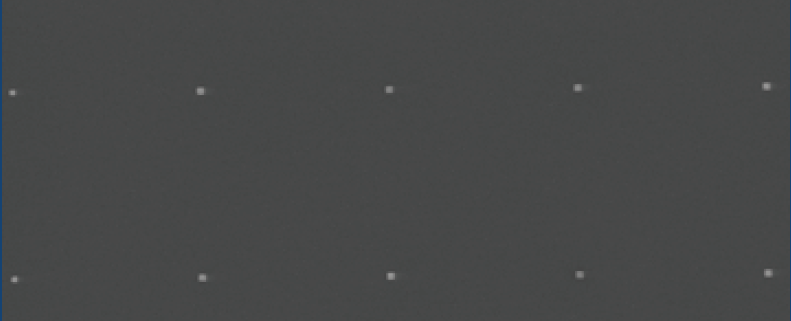
200 nm-squares written on quartz without distortion caused by charges with AR-P 662.04 and AR-PC 5092.02

Conductivity measurements of the spin-coated layers of the AR-PC 5092.02. With thinner layers, the resistance increases and the conductivity decreases.
Please contact us for further requests.
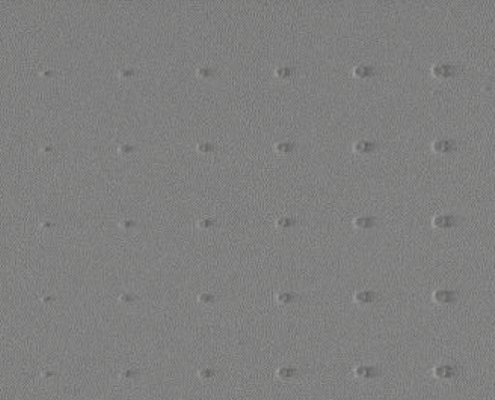
Fig.: 30 – 150 nm squares of the CSAR 62 on glass.
The combination of CSAR 62 with AR-PC 5090.02 offers the best possibilities to perform complicated e-beam patterning on glass, quartz or semi-insulating substrates such as gallium arsenide. The very good sensitivity and highest resolution of the CSAR are harmoniously complemented by the conductivity of the Electra.

200 nm squares produced with 2-layer PMMA lift-off
Initially, the PMMA resist AR-P 669.04 (200 nm thickness) was coated on a quartz substrate and tempered. The second PMMA resist AR-P 679.03 was then applied (150 nm thickness) and tempered, followed by coating with Electra 92. After exposure, Electra 92 was removed with water, the PMMA structures were developed (AR 600-56) and the substrate vaporised with titanium/gold. After a liftoff with acetone, the desired squares remained on the glass with high precision.